
This is the third in the new series of blogs which will start with relevant extracts from the Bach Commission’s Final Report. These will be followed by the more detailed treatment I gave to the topic in one of the chapters in Appendix Five to the Report Continue reading “The Bach Report: (5) Family Law”
Author: Henry Brooke
I am a retired judge. I was formerly chair of the Prisoners of Conscience Appeal Fund, and am the sole patron of the Public Law Project. My work for the Slynn Foundation and Peace Brigades International (UK) involved me in helping justice systems in Eastern Europe and beleaguered human rights defenders, particularly in Central and South America. I am married, with four children and seven grandchildren.
The last Canadian case in the Privy Council (1)
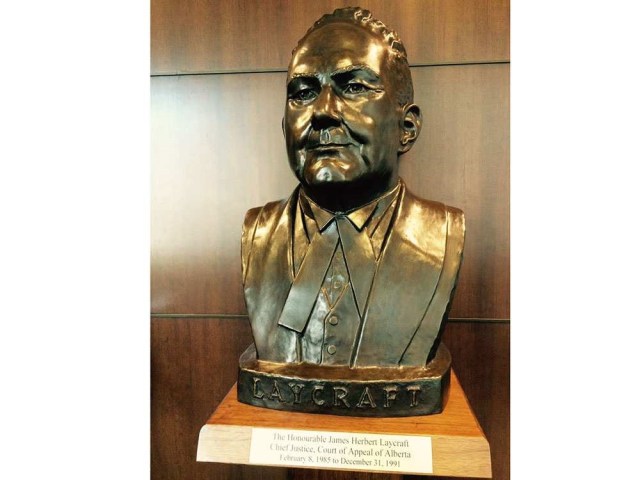
James Herbert (Herb) Laycraft, a former Chief Justice of the Alberta Court of Appeal, died in August 2015 at the age of 91. The Calgary Herald, announcing his death, wrote:
It’s hard to fathom how different the legal profession might be today for Albertans and the rest of Canadians, for that matter, if not for the gigantic footprints left behind by James Herbert (Herb) Laycraft over a momentous four-decade career as a litigator and judge.
Nearly a year later the current holder of that , Catherine Fraser (who greeted me on my only visit to her province in 2001 with the gift of a bowl of fruit) unveiled this bust at the Cavalry Courts Centre (which I did not visit: I remember that Calgary was full of multi-coloured sculpted cows when I was there).
She said that Chief Justice Laycraft was
“a mixture of the practitioner, the scholar, the reformer, the mentor and the administrator. [He] was instrumental in helping shape the post-Charter world in which we now live. An elegant and compelling writer, Herb wrote a number of the leading judgments of his era. He combined a true talent for precise analytical reasoning with unfailing courtesy and fairness. His respect and consideration for others were exhibited in his sensitive and balanced approach to the law.”
Jim Laycraft told the Calgary Herald that in 1959 his father had been lucky enough to go on the last Canadian case that went to the Privy Council in Britain, in a case that had dragged on for a decade after changes to the Privy Council in 1949.
This blog contains his father’s memory of that case, as recounted to my indefatigable Canadian friend John de P Wright – and by him to me.
The name of the case was Ponoka-Calmar Oils ltd v Earl F. Wakefield Co. The point at issue was whether the appellants’ mechanics’ lien (which came into existence after they had been unpaid for some oil-drilling work they had done) followed the proceeds of sale after a Receiver had sold the oil and gas which were subject to the lien and paid the proceeds of sale into court to await further order. The Privy Council upheld the Supreme Court of Canada in giving the answer “yes” to this question.
At that time Herb Laycraft was 35. He was one of five counsel who signed the Respondents’ case. Another was Percy Grieve QC, MP, the father of Dominic Grieve QC MP (who was our Attorney-General until 2014). Godfrey LeQuesne, who became a giant of Privy Council practice – I remember him on the other side in the first case in which I appeared before the Privy Council[1]) – was junior counsel for the appellants.
Herb had three memories of this case:
“One point of interest, is the process of renting a wig in London. I was dispatched by our London agents to see a most impressive gentleman in a wig shop near Gray’s Inn He took a wooden device with many spokes going inside a square frame which he put around my head. Then he pushed in the spokes until they all touched my head.in a dozen or so places. I present some challenge in that respect. But he showed no sign of despondency as he placed the spokes against the various planes, points, knobs and angles of my head. He went away and a few moments later arrived with a wig with the strings inside all adjusted and dropped it on my head; it was a perfect fit. Fortunately I didn’t offer money; I gave him my card with the London Agent’s name written on the back. Gentlemen don’t discuss money.
When everyone had his wig, Bill Morrow produced a photographer who was singularly lacking in talent. The photograph he took now hangs in the Court House at Calgary. We all look like we had had bad clams for lunch.”
“On the opening day it was necessary to arrive early for rehearsal on how to enter the room to appear before the Judicial Committee. That was a very formal process and the Registrar was plainly dubious that we had the wit to master it. The process started with all the Judicial Committee seated at their table in the room and all counsel outside in the hall. You then entered one at a time, in strict order of seniority. You took ten steps into the room to a point where a brass plate was inset into the floor. You stopped and bowed. Then you took another ten steps to a second brass plate, bowed again and then turned left, if an appellant, and right, if a respondent, and went to your seat.
The argument commenced with Viscount Simonds pointing out that they did not have a mechanic’s lien statute in England and so ‘let us read through this one’. Bill Morrow commenced to highlight it but was quickly made aware that they meant what they said. Read it through clause by clause. He spent most of the first day doing just that. At the conclusion, Lord Denning remarked: ‘a most enlightened statute’.
I have one other bit of trivia. A prerogative of counsel appearing before the Privy Council was to have lunch in the House of Lords dining room if special arrangements were made. Our London agents arranged that for us but, of course, a certain protocol had to be observed. On the appointed day, we left the Privy Council Building (No. 14, Downing Street) and proceeded fully robed and wearing wigs in single file across 6 or 8 lanes of traffic to the House of Lords across the street. The traffic constable stopped all traffic for our stately march while tourist cameras whirred and clicked. We arrived at the House of Lords where we were served a meal that has my nomination for the title
“Worst since the Invention of Cooking Over Fire”.
Again, of course, money was not discussed but I have often wondered what our London agents paid for that meal.
[1] Guiana Industrial & Commercial Investments Ltd v Inland Revenue Commissioners [No 2) [1971] AC 841. I appeared there as counsel on only one other occasion before I sat there occasionally as a judge following my retirement from the Court of Appeal. That was an appeal as of right from the Court of Appeal in Fiji in a fatal accidents case which arose after a car had collided with a steam engine puffing its way through a sugar cane plantation. The only issue was apportionment of liability. Once again, I was on the losing side. See Santlal v South Pacific Sugar Mills Ltd (Judgment No 11 of 1974).
The Bach Report: (4) Legal aid lawyers & the effect of LASPO
This is the second in the new series of blogs which will start with relevant extracts from the Bach Commission’s Final Report. These will be followed by the more detailed treatment I gave to the topic in one of the chapters in Appendix Five to the Report Continue reading “The Bach Report: (4) Legal aid lawyers & the effect of LASPO”
The Bach Report: (3) The use of technology

This is the first of a series of blogs which will start with relevant extracts from the Commission’s Final Report. These will be followed by the more detailed treatment I gave to the topic in one of the chapters in Appendix Five to the Report Continue reading “The Bach Report: (3) The use of technology”
The Bach Report: (2) My article for the Gazette
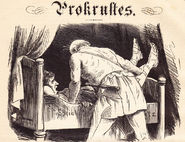
Once upon a time the traveller from Athens to Eleusis was at risk of capture by a B & B proprietor with marked anti-social tendencies. If you were too long for his bed, he would cut you down to size. If too short, he would stretch you out on his do-it-yourself home body rack.
Continue reading “The Bach Report: (2) My article for the Gazette”
The Bach Report: (1) Its message
In this blog I am reproducing the Foreword, the Executive Summary, and the List of Recommendations contained in the Report on Access to Justice, published today by the Fabian Society. Continue reading “The Bach Report: (1) Its message”
Failures in prosecution disclosure
The blog I posted earlier today has attracted some interesting comments in response, and has already attracted over 170 “views”. Continue reading “Failures in prosecution disclosure”
Some thoughts about the Lammy Report
In his thought-provoking report on disparity of treatment within the criminal justice system David Lammy has again seized on a worrying statistic Continue reading “Some thoughts about the Lammy Report”
The Bach Commission: Stories of Injustice (Volume 2)
By Sir Henry Brooke
This is the second volume of the Stories of Injustice I originally published last year. Their republication in this consolidated form has been timed to precede by a few days the publication of the Bach Commission’s Report on 22nd September 2017. Continue reading “The Bach Commission: Stories of Injustice (Volume 2)”
The Bach Commission: Stories of Injustice (Volume 1)
In advance of the publication of the report of Lord Bach’s Access to Justice Commission (of which I am now the Vice-Chair), I am republishing in two volumes the Stories of Injustice which I first published in July 2016. Continue reading “The Bach Commission: Stories of Injustice (Volume 1)”
 Henry Brooke